
Keeping swimming pools clean and safe takes effort. Are you spending too much time or money on pool chemicals? Calcium hypochlorite is a trusted solution for many pool professionals.
Calcium hypochlorite is preferred because it's a powerful disinfectant in a stable, solid form. It's easier to store and handle than liquid bleach and effectively kills bacteria, algae, and other harmful things.
Choosing the right disinfectant is crucial for pool maintenance. Let's explore why calcium hypochlorite stands out and how it compares to other options, helping you make the best choice for your business and clients. Read on to learn more.
Why is calcium hypochlorite a good pool disinfectant?
Need strong, reliable pool sanitation? Worried about unseen germs or annoying algae blooms ruining the swim experience? Calcium hypochlorite offers effective protection against both common pool problems.
It's a great disinfectant because it quickly releases chlorine in water. This chlorine kills a wide range of bacteria, viruses, and algae. Its oxidizing power also breaks down swimmer waste effectively.
Calcium hypochlorite works by releasing hypochlorous acid (HOCl) when dissolved in water. This is the active sanitizing agent that does the heavy lifting. HOCl is very effective at penetrating the cell walls of microorganisms and destroying them. One thing I've found particularly useful in my experience is its ability to also prevent algae growth1. This often means you don't need a separate algaecide, which simplifies chemical routines and can save costs. It also helps oxidize organic contaminants2 left behind by swimmers, like sweat and oils, keeping the water clear and pleasant. However, getting the dose right manually can be tricky. Adding too little won't sanitize properly, and adding too much can be harsh on swimmers and equipment. This is where consistent application becomes key.Calcium hypochlorite works by releasing hypochlorous acid (HOCl) when dissolved in water. This is the active sanitizing agent that does the heavy lifting. HOCl is very effective at penetrating the cell walls of microorganisms and destroying them. One thing I've found particularly useful in my experience is its ability to also prevent algae growth. This often means you don't need a separate algaecide, which simplifies chemical routines and can save costs. It also helps oxidize organic contaminants left behind by swimmers, like sweat and oils, keeping the water clear and pleasant. However, getting the dose right manually can be tricky. Adding too little won't sanitize properly, and adding too much can be harsh on swimmers and equipment. This is where consistent application becomes key.
Key Actions of Calcium Hypochlorite:
- Sanitization: Kills harmful bacteria and viruses.
- Oxidation: Breaks down organic waste.
- Algae Control: Prevents and kills algae growth.
| Feature | Benefit |
|---|---|
| Active Sanitizer | Hypochlorous Acid (HOCl) |
| Spectrum | Broad (bacteria, viruses, algae) |
| Secondary Action | Oxidation of organic contaminants |
| Algae Prevention | Reduces need for separate algaecide |
| Form | Solid (granules or tablets) |
| Manual Dosing | Can be inconsistent, requires careful work |
What is the best method for disinfection of swimming pools?
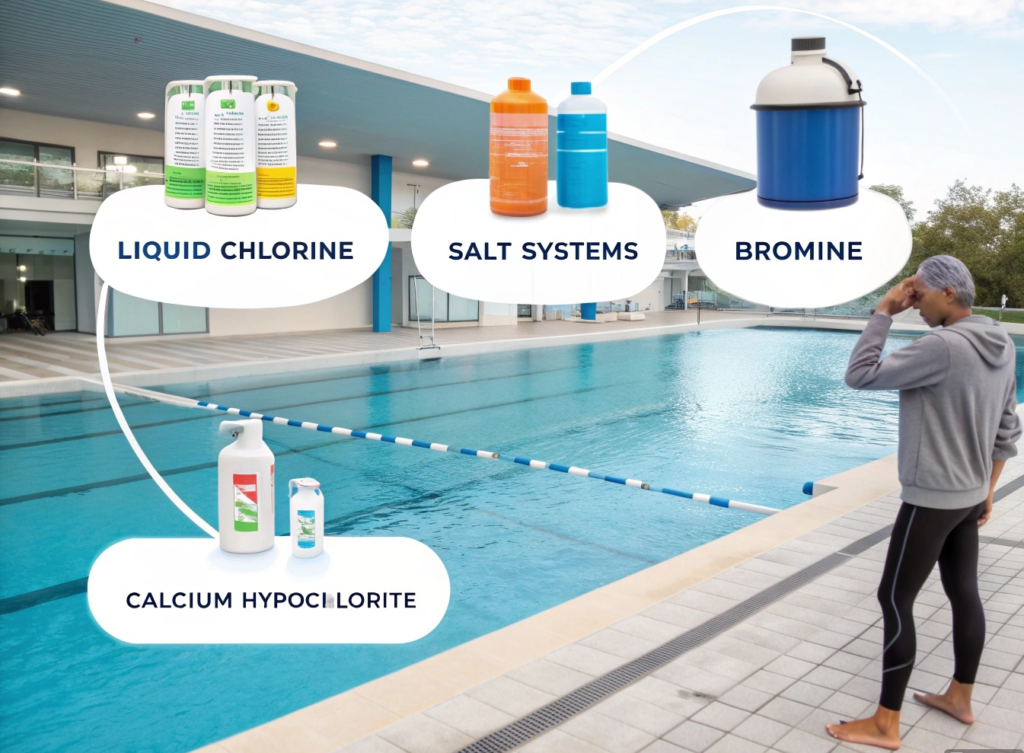
Choosing the right pool disinfectant feels complex sometimes. With options like liquid chlorine, salt systems, bromine, and calcium hypochlorite, how do you pick the best one for your needs?
There isn't one single "best" method for everyone. But, calcium hypochlorite, especially when used with an automated dosing system, is a very strong contender. It balances effectiveness, ease of use, and reliable sanitation.
Let's break down the key differences. Sodium hypochlorite, or liquid bleach, is mostly water. This means you need large volumes, which takes up significant storage space and makes transport more cumbersome. It also degrades over time, losing potency, especially when exposed to heat or sunlight. This means you might need to use more product than expected to achieve the desired chlorine level, impacting cost-effectiveness.
Calcium hypochlorite, on the other hand, is a concentrated solid. A smaller amount provides more [available chlorine](https://www.tidjma.tn/en/glenv/available-chlorine-/)1. Its solid form makes it much more stable during storage; it retains its strength for longer periods. This is a big advantage for businesses that buy in bulk or operate in warmer climates like Southeast Asia. While it does add [calcium hardness](https://www.taylortechnologies.com/it/page/169/understanding-calcium-hardness)2 to the pool water, which needs monitoring, the benefits in handling, storage, and concentration often outweigh this for many professional operations. The higher initial cost per pail might seem more, but its concentration and stability can lead to better value over time.
Comparing Common Disinfection Methods:
| Method | Pros | Cons | Best For |
|---|---|---|---|
| Calcium Hypochlorite | Strong, stable, easy storage, algae control | Manual dosing tricky, adds calcium hardness | Commercial pools, high bather loads |
| Sodium Hypochlorite | Effective, no calcium added | Bulky, degrades quickly, lower chlorine strength | High volume users with good storage |
| Salt Chlorine Generator | Convenient, continuous chlorine | High initial cost, cell maintenance, salt buildup | Residential pools, lower bather loads |
| Bromine | Stable at high temps, less odor | More expensive, slower acting than chlorine | Spas, hot tubs, indoor pools |
| Cal Hypo + Automation | All Cal Hypo pros + Consistency, Efficiency | Initial equipment cost | Professional pool service, large facilities |
Why is calcium hypochlorite preferred than sodium hypochlorite?
Deciding between different types of chlorine can be confusing. You might wonder why solid calcium hypochlorite is often chosen over liquid sodium hypochlorite (bleach)? Practical reasons often make the difference.
Calcium hypochlorite is often preferred for its higher chlorine concentration (65-75% vs 10-12%), better storage stability, and ease of transport. It takes up less space and doesn't degrade as quickly as liquid bleach.
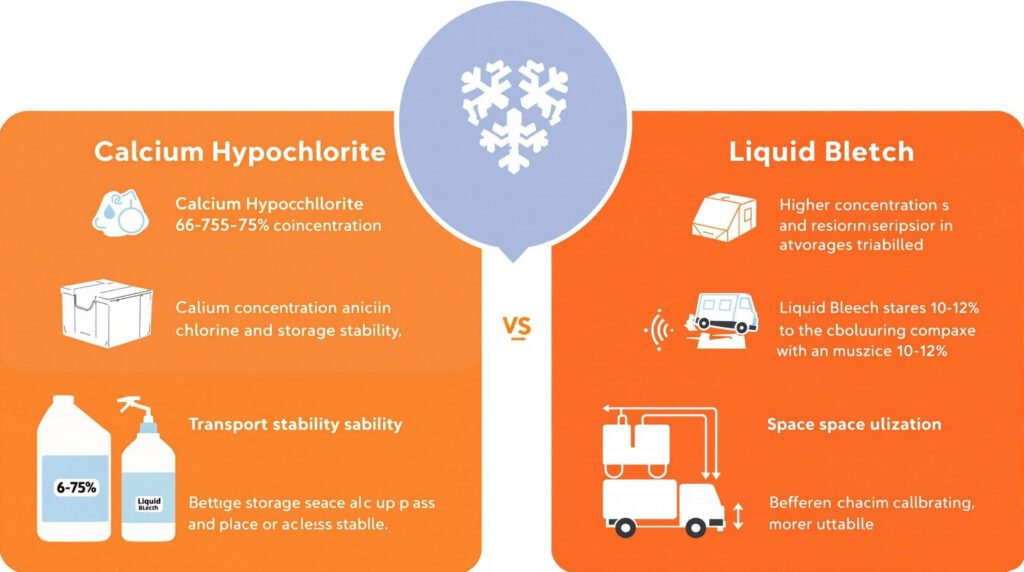
Let's break down the key differences. Sodium hypochlorite, or liquid bleach, is mostly water. This means you need large volumes, which takes up significant storage space and makes transport more cumbersome. It also degrades over time, losing potency, especially when exposed to heat or sunlight. This means you might need to use more product than expected to achieve the desired chlorine level, impacting cost-effectiveness.
Calcium hypochlorite, on the other hand, is a concentrated solid. A smaller amount provides more available chlorine. Its solid form makes it much more stable during storage; it retains its strength for longer periods. This is a big advantage for businesses that buy in bulk or operate in warmer climates like Southeast Asia. While it does add calcium hardness to the pool water, which needs monitoring, the benefits in handling, storage, and concentration often outweigh this for many professional operations. The higher initial cost per pail might seem more, but its concentration and stability can lead to better value over time.
Calcium Hypochlorite vs. Sodium Hypochlorite:
| Feature | Calcium Hypochlorite (Solid) | Sodium Hypochlorite (Liquid) | Why it Matters for Professionals |
|---|---|---|---|
| Available Chlorine | 65-75% | 10-15% | Need less product for same effect |
| Form | Granules/Tablets | Liquid | Easier handling, less spill risk |
| Storage Stability | Good, long shelf life | Poor, degrades quickly | Less waste, more reliable dosing |
| Storage Space | Compact | Bulky | Saves valuable storage space |
| Transport | Easier, less weight/volume | Heavier, more volume | Lower shipping costs, easier logistics |
| pH Impact | Increases pH | Significantly increases pH | Both require pH adjustment |
| Calcium Hardness | Increases | Does not increase | Requires monitoring/balancing |
| Cost per Active Cl | Can be lower due to concentration | Can be higher due to degradation | Important for budget management |
What are the advantages of calcium hypochlorite?
So, what are the specific benefits that make calcium hypochlorite a strong choice? If you're weighing your options, knowing the key advantages helps clarify if it fits your pool management needs.
Key advantages include powerful broad-spectrum sanitation, effective algae control, excellent storage stability, high chlorine concentration, and relative ease of handling compared to liquid bleach or chlorine gas.

Calcium hypochlorite offers several compelling benefits for pool professionals. Its primary advantage is strong, effective sanitation. It reliably kills bacteria, viruses, and other pathogens that compromise water safety. As I mentioned, its ability to control algae is a significant plus, streamlining chemical treatment. The stability of the solid form is a major operational advantage – it doesn't lose strength quickly in storage, ensuring you get the potency you pay for. Being concentrated means less product handling and storage space compared to liquids.
While manual application requires care, the granular or tablet form is generally easier and safer to handle than large volumes of liquid bleach or dangerous chlorine gas. For businesses like SIAU's in Malaysia, dealing with high temperatures, the stability factor is especially important. The main drawback, potential inconsistency with manual dosing, is effectively solved by using automated dosing systems. My experience shows that pairing calcium hypochlorite with automation transforms it into a highly efficient, reliable, and cost-effective solution for maintaining pristine pool water consistently. This combination truly leverages all the inherent advantages of calcium hypochlorite.
Summary of Advantages:
- Potent Sanitizer: Kills a wide range of harmful microorganisms.
- Effective Oxidizer: Breaks down swimmer waste and contaminants.
- Built-in Algaecide: Helps prevent and kill algae growth.
- High Chlorine Concentration: More "bang for your buck" per pound/kilo.
- Stable for Storage: Long shelf life, less degradation.
- Compact Form: Saves storage space compared to liquids.
- Ease of Handling: Generally safer and easier than liquid bleach or gas.
- Optimized with Automation: Achieves peak efficiency and consistency when dosed automatically.
Conclusion
Calcium hypochlorite is a powerful and stable pool sanitizer. Its effectiveness is maximized, and handling simplified, especially when paired with automated dosing systems for consistent, reliable pool water quality.